


Please share your view on #diets including #plantbased etc.
https://docs.google.com/forms/d/e/1FAIpQLSe_bqT4tcgiSPOQURVomn-rlK2FYkr1CgbeWsIWaW-KSJrkxg/viewform
Please share your view on #diets including #plantbased etc.
https://docs.google.com/forms/d/e/1FAIpQLSe_bqT4tcgiSPOQURVomn-rlK2FYkr1CgbeWsIWaW-KSJrkxg/viewform
We are hearing from the market that some feel that the proposed Malaysia "limit" to oil palm area is a signal for expansion! The area limit (first mooted at a lower level, then raised) has been suggested as a measure to improve the image of Malaysian palm oil against foreign accusations of deforestation. At the same time, it may ease palm's supply glut (resulting from rapid expansion when palm prices were buoyed in the biofuels boom).
Some figures may explain this alleged “pro expansion” mood. 6.5 million hectares is significantly higher than the current licensed area; and the implied pace of expansion would be 130,000 hectares per year for a push to the limit by 2023 (the “target” year mooted by the government, see red line in chart). This is a significantly faster pace than recent growth in hectarage (blue line) of 69,000 hectares per year in the recent 3 years.
But if there is an upward revision of planted area, of say 5%, the pace of expansion to reach the limit could be 80,000 hectares per year (yellow line; not so far off the recent 3-year average change).

How would the area expansion be distributed? Or perhaps 2023 is not a “target” year and upstream industry players are quite mistaken in interpreting it this way.
Read more at Palm Weekly!
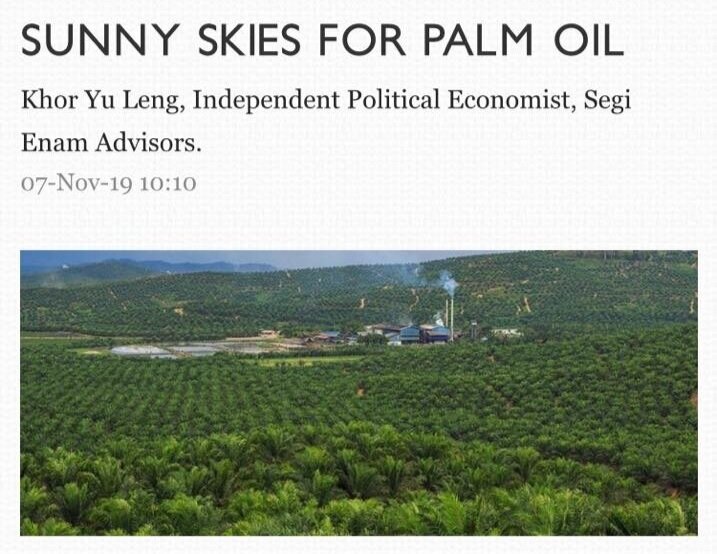
Last week, BFM invited Segi Enam Advisors principal, Khor Yu Leng, to give her views on the future of Malaysian and Indonesian biodiesel policies following the recent hike in crude palm oil (CPO) prices. Click here for the link to the podcast.
“With CPO prices hitting a 22 month high of RM2500, we ask why and when output has been on a rise. Khor Yu Leng, independent political economist with Segi Enam Advisors tells us that the biodiesel policy of both Indonesia and Malaysia have a role to play in this recent price rally.
Presented by: Lyn Mak, Wong Shou Ning, Roshan Kanesan.”
In a brief moment of levity, Khor Reports has decided to (finally) hop on the boba bandwagon and find out what the hype’s about. After a bit of internet trawling, we now have a dashboard of selected boba brands across Malaysia and a bit of market information on the popular drink.
Being the wet blanket as we are though, we decided to also add in information about sugar consumption and how the boba faze might not help health-wise in the long run. (We’re sorry, we care too much to ignore this.)
Click here to read the full post!
The Pakatan Harapan government has announced plans to achieve its target share of 20% renewable energy mix in the nation’s electricity supply by prioritising solar-PV. The question: is this really a viable move? Khor Reports spoke to Ir. Krishna Moorthy of MECC Engineering Sdn Bhd to find out.
This is the first of Khor Reports’ Talking Series, featuring the topic of renewable energy in Malaysia. Click here to read the full post.
In October 2018, Malaysia banned the imports of contaminated plastic wastes in effort to restrict the supply of waste plastics into the country. Despite the ban, data shows that monthly plastic waste imports is beginning to increase. The Pakatan Harapan administration has even flirted with ideas to build at least one incinerator in each state (and we have thirteen of them!).
Khor Reports has consolidated data on waste plastics issues in a dashboard, with information compiled from media reports. This provides an overall view of plastic waste imports and the concerns it has raised for the Malaysian people. The data is as at 27 September 2019, collected by a group of dedicated volunteers over a period of about two weeks.
Out of sight, out of mind, when it really shouldn’t be. Click here for the full post and the dashboard.
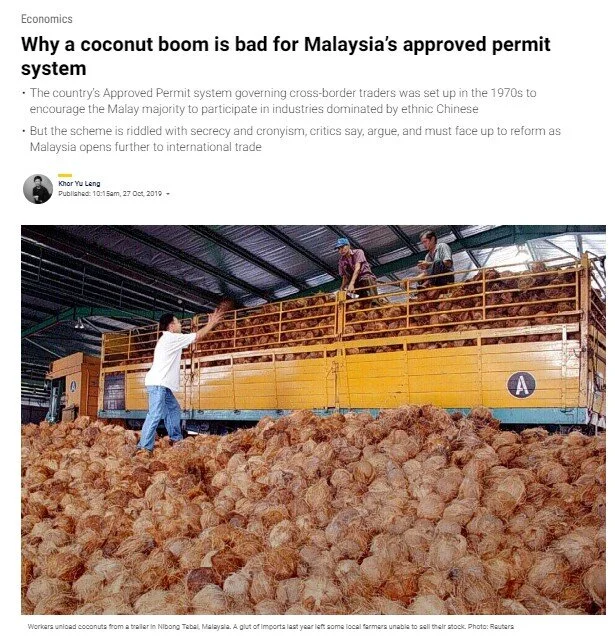
In the SCMP, our write up on "Why a coconut boom is bad for Malaysia’s approved permit system"
The country’s Approved Permit system governing cross-border traders was set up in the 1970s to encourage the Malay majority to participate in industries dominated by ethnic Chinese
But the scheme is riddled with secrecy and cronyism, critics say, argue, and must face up to reform as Malaysia opens further to international trade
Read Yu Leng’s economic commentary in SCMP, here
Also refer to our other findings:
Live radio spot on BFM 89.9 - The Business Station on The Rise of #Trade Sanctions. Khor Yu Leng, Independent political economist, Segi Enam Advisors 21-Oct-19 18:40
We examine the precarious posiiton we may find ourselves in as our country and economy continues to stand between the trade tensions of the US and China.
Produced by: Lee Chwi Lynn, Tasha Fusil
Presented by: Lee Chwi Lynn, Kelvin Yee
Tags: Evening Edition, #USChina, #tradewar, #sanctions, #economy, Tun Dr #Mahathir, CEO/Business leaders, Economy, Markets, Politics, News, Current Affairs

It is up! After a couple of months of mining and examining about 3,300 lines of data, Khor Reports is pleased to present to you our preliminary view of durians in China.
In the post, we talk about the spike in interest for the King of Fruits as well as the possible ramifications of the rather dramatic increase in demand for durians from China. We’ve also thrown in a dashboard of consolidated data which illustrates an overall view regarding the local durian farmscape, products, and China retail indicators—feel free to play around with it!
Click here to read the full post.
#Durian #MusangKing #China #Malaysia #ChinaMalaysia
The NEW Durian Economics of Malaysia: Exports, farms and the competitive landscape by Khor Yu Leng, Sep 2019
Reviews certified supply-chain and farmscape of Malaysia, product competitive landscape in China and its key provinces, public interest in durian and other imported fruits, Thailand export status, and price indicators (farm, export, import and China retail).
A must for those eyeing the export market.
Please contact yuleng@segi-enam.com