Watch out for synchronous fire weather days, which can sharply increase major wildfire risks. I’ve been tracking this for over a decade, and earlier research highlighted a key uncertainty in climate modelling: cloud cover over equatorial regions. This new work adds useful detail for those of us in #SoutheastAsia, especially in understanding rising atmospheric humidity, cloud formation, and associated flood risks. Several studies help support the view that atmospheric humidity and moisture‑related extremes are changing over Southeast and equatorial Asia, even as cloud feedbacks and moisture patterns remain areas of model uncertainty.
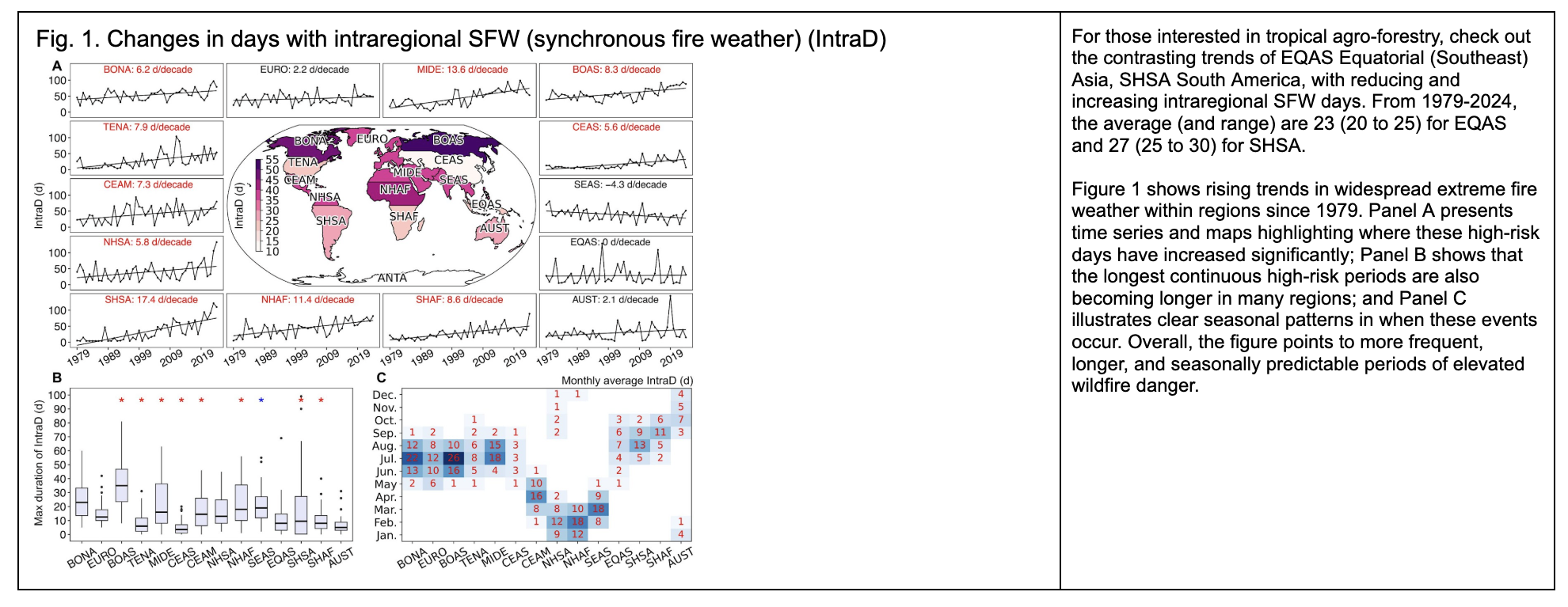
“Increasing Synchronicity of Global Extreme Fire Weather” by Yin et al. (2026) notes that concurrent extreme fire weather can enable widespread large fires, strain firefighting coordination, and degrade air quality. The study finds elevated synchronous fire weather in boreal regions and strong interregional links across northern temperate zones, with a more than twofold rise in many regions from 1979 to 2024 - over half attributable to anthropogenic climate change. South America shows the largest increase, linked to warming and drying, while tropical regions such as Equatorial (Southeast) Asia show declining trends, likely due to increased atmospheric humidity. Extreme fire weather-marked by dry, windy, and warm conditions-heightens ignition risk and fire spread.
Importantly, climate variability such as the El Niño–Southern Oscillation (#ENSO) significantly amplifies fire risk, bringing around 43 additional high-risk fire weather days to Equatorial Asia during El Nino years and increasing fire-related PM2.5 pollution and health impacts. At Khor Reports – Segi Enam Advisors, we have worked with colleagues at Singapore Institute of International Affairs on annual Haze Outlook reports since 2019 - do check them out ( 2025, 2024, 2023, 2022, 2021, 2020 and 2019). We are currently preparing the 2026 outlook.
Reach us at khorreports@gmail.com for more information!